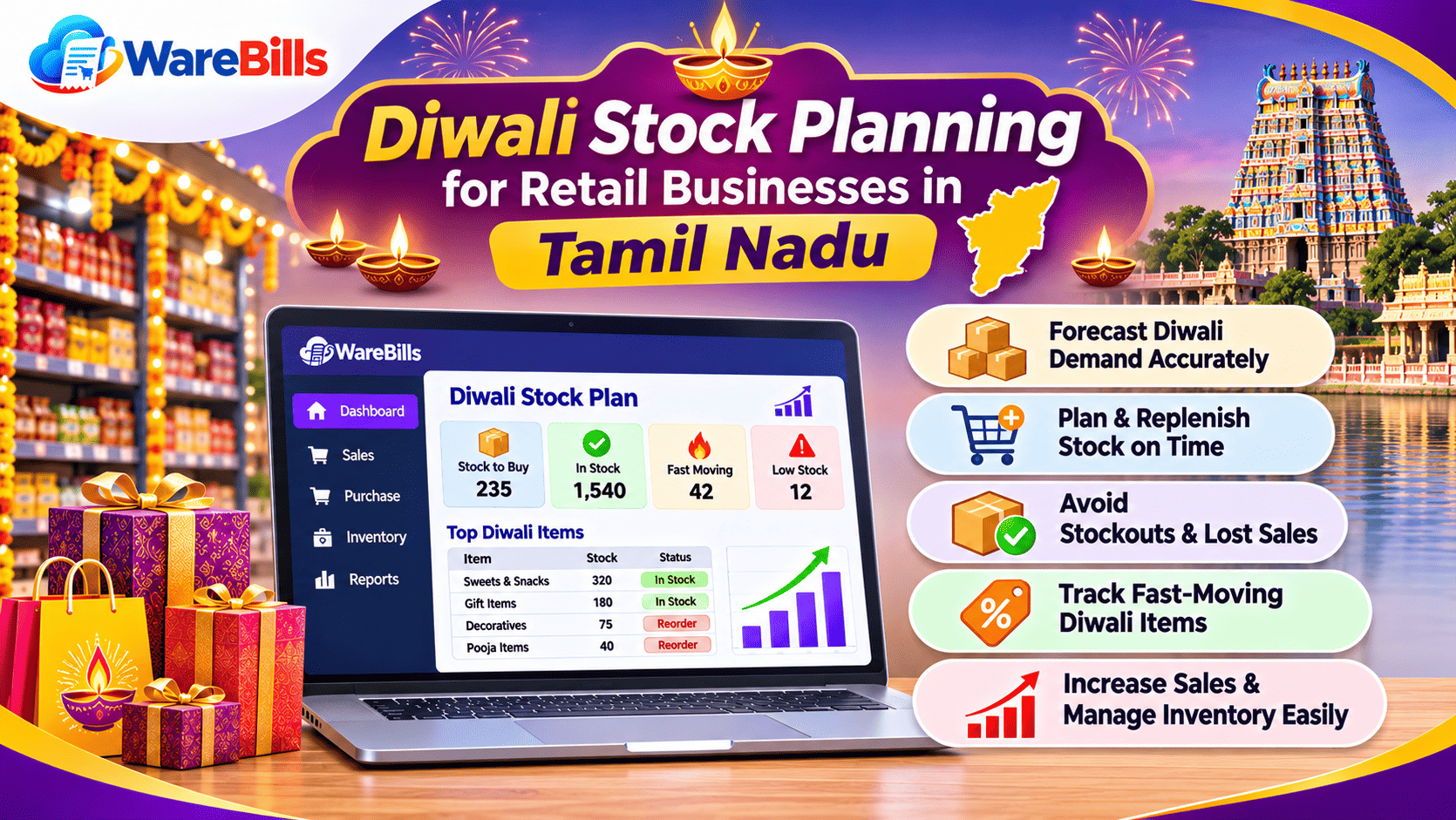
However, higher demand can also create challenges. Ordering too little stock may lead to missed sales, while purchasing too much can leave businesses with unsold products after the festival ends.
Effective festival stock planning helps retailers prepare for changing customer demand, coordinate purchases with suppliers and maintain better control over inventory.
In this guide, we will explore practical ways for seasonal retailers in Tamil Nadu to plan festival stock, manage fast-moving products and reduce avoidable inventory problems.
1. Review Previous Festival Sales
Start by reviewing sales from previous festival periods. Historical sales records can help you understand which products sold well, which products moved slowly and when demand increased.
Review information such as:
- Products sold during the previous festival
- Quantities sold by product or category
- Opening stock and remaining stock
- Products that went out of stock
- Supplier delivery times
- Discounts and promotional activity
- Unsold stock remaining after the festival
For example, a clothing retailer can compare sales of traditional wear, children's clothing and accessories during previous Diwali periods.
Use this information as a starting point rather than assuming that the coming season will produce identical demand. Weather, customer preferences, local competition, pricing and economic conditions can all influence sales.
2. Identify Products Likely to Sell During Festivals
Not every product experiences the same increase in demand. Identify the categories most relevant to your customers and plan inventory accordingly.
These are examples, not guaranteed sales predictions. Use your own sales records, customer enquiries and supplier information to determine which products deserve additional stock.
3. Forecast Demand Before Placing Orders
Demand forecasting helps you estimate how much stock you may need during a festival period.
A simple starting point is to review the average daily sales of a product during a comparable previous period and adjust the estimate based on current conditions.
For example, suppose a retailer sold 20 units of a product per day during a comparable five-day festival period. If the retailer expects demand to be approximately 15% higher this year, the estimated daily demand would be:
20 × 1.15 = 23 units per day.
For five days, the estimated demand would be 115 units, before considering existing stock, incoming deliveries and any additional safety stock.
This is an illustrative calculation, not a guarantee of actual demand.
Consider factors such as current sales trends, confirmed orders, local events, planned promotions and changes in product popularity. For new products without historical sales, use smaller initial orders and review customer response before purchasing more.
4. Set Appropriate Stock Levels
Once you have estimated demand, determine how much stock to keep available.
A basic planning approach is:
Planned purchase quantity = Forecast demand + Desired closing stock − Available stock − Confirmed incoming stock
For example:
- Forecast festival demand: 300 units
- Desired closing stock: 30 units
- Available usable stock: 100 units
- Confirmed incoming stock: 50 units
Planned purchase quantity = 300 + 30 − 100 − 50 = 180 units.
Before placing an order, account for supplier minimum order quantities, expected delivery dates, cash flow and the risk of leftover stock.
Avoid automatically applying the same increase to every product. A fast-moving essential item and a fashion product with uncertain demand may need very different purchasing strategies.
5. Place Orders Early and Coordinate With Suppliers
During festival periods, suppliers may experience higher order volumes, delivery delays or limited availability.
Prepare a purchasing schedule that identifies when each product must be ordered to arrive before the expected sales period.
Consider:
- Supplier lead time
- Minimum order quantity
- Delivery schedules
- Supplier holiday closures
- Payment terms
- Availability of alternative suppliers
- Product shelf life or expiry dates
Confirm important orders with suppliers rather than relying only on estimated delivery dates.
For products with uncertain demand, consider smaller orders with planned replenishment where suppliers can support it. This can reduce the risk of tying up too much money in slow-moving stock.
6. Separate Fast-Moving and Slow-Moving Products
A common festival inventory mistake is treating every product as equally important.
Use sales data to group products according to demand, sales value or replenishment difficulty.
For example:
- Fast-moving products: Review frequently and replenish before stock becomes critically low.
- Steady-selling products: Maintain stock based on normal demand and expected seasonal changes.
- Slow-moving products: Purchase cautiously and avoid large seasonal increases without supporting evidence.
- High-value products: Monitor purchasing commitments and cash tied up in inventory.
You can also identify items that require special handling, have short shelf lives or are difficult to replenish quickly.
This approach helps businesses focus attention on products where a stockout or over-purchase could have a greater impact.
7. Monitor Stock During the Festival Period
Festival planning should continue after the initial purchase. Daily sales may differ considerably from your forecast.
Check stock movement regularly during the busy period. Identify products that are selling faster than expected and those that are moving slowly.
A practical daily review includes:
- Check opening stock and current available quantities.
- Review sales by product.
- Identify products nearing their reorder threshold.
- Confirm incoming supplier deliveries.
- Adjust replenishment orders based on remaining demand.
- Review price changes, returns and damaged goods where relevant.
For example, if a product sells twice as quickly as expected during the first few days of a promotion, you may need to check whether additional stock can arrive in time.
Do not reorder automatically without checking the remaining festival period, supplier lead time and likely demand.
8. Prevent Stockouts Without Overstocking
Stockouts and excess stock can both reduce business performance.
A stockout may cause a missed sale or disappoint a customer. Overstocking can tie up cash, consume storage space and leave the retailer with products that are difficult to sell later.
To reduce these risks:
- Set reorder levels for important products.
- Include supplier lead times in purchasing decisions.
- Maintain a reasonable safety-stock allowance for products with uncertain demand.
- Review stock levels more frequently during peak periods.
- Avoid bulk purchases based only on supplier discounts.
- Track stock already ordered but not yet received.
- Prepare a plan for selling seasonal leftovers.
Safety stock should reflect demand variability, delivery reliability and the cost of a stockout. Keeping extra stock for every product is not necessarily the best solution.
9. Plan Discounts and Leftover Stock in Advance
Some seasonal products may remain unsold after the festival. Planning for this possibility before placing orders can reduce avoidable losses.
Before the season begins, decide how you will handle products that remain after the peak period.
Possible approaches include:
- Continuing to sell products that remain relevant year-round
- Offering a carefully calculated discount on suitable remaining stock
- Bundling compatible products where financially sensible
- Reducing future orders for categories that repeatedly remain unsold
- Returning eligible goods to suppliers when an agreed return arrangement exists
Check product expiry dates, storage requirements and return conditions before making decisions.
Do not wait until the final day to review leftover stock. Monitor sales throughout the festival so you can make reasonable adjustments while demand still exists.
10. Use Billing and Inventory Records for Better Planning
Accurate sales and inventory records make festival planning more manageable. Without reliable records, retailers may place duplicate orders, overlook existing stock or misunderstand which products are selling well.
Maintain records of:
- Opening stock
- Purchases and supplier deliveries
- Sales by product
- Sales returns and purchase returns
- Damaged or expired stock
- Stock transfers between locations, where applicable
- Closing stock
- Outstanding purchase orders
Billing and inventory software may help businesses organise these records and review available sales reports, depending on the system's features.
WareBills is an option retailers can evaluate for their billing and inventory management requirements. Before choosing any system, confirm whether its available features support the reports, stock controls and workflows your business needs for festival preparation.
Reliable records are useful only when staff update transactions correctly and investigate differences between recorded and physical stock.
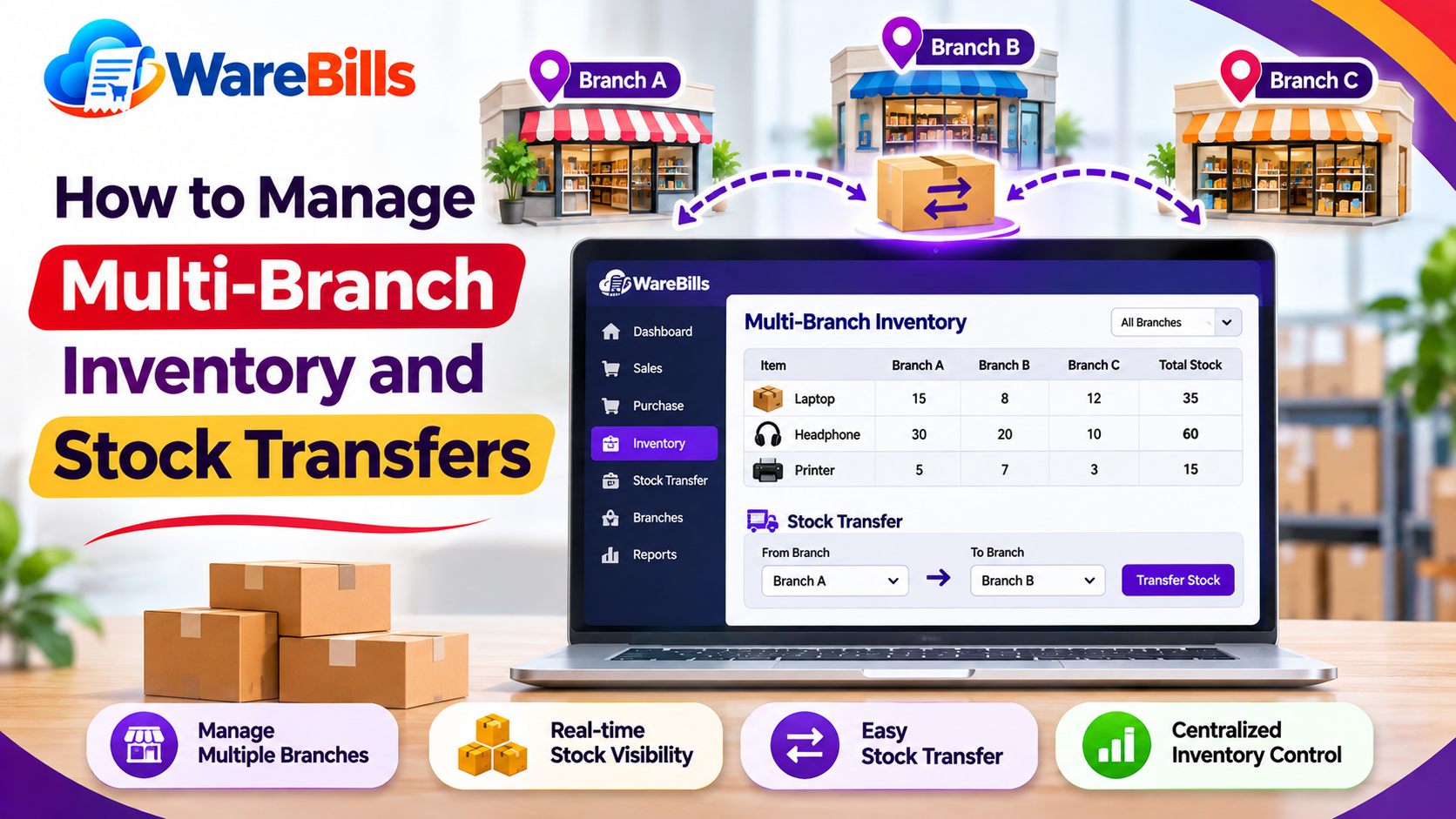
11. Plan Festival Stock Across Multiple Locations
Businesses operating more than one shop or warehouse need to consider where stock is located, not just the total quantity available.
A product may be available in one branch while another branch experiences a stockout.
Prepare a location-wise stock plan that records:
- Available stock at each location
- Forecast demand by branch
- Incoming supplier deliveries
- Planned stock transfers
- Minimum stock levels for important products
Before transferring stock, check whether the sending location can spare the quantity without creating its own shortage. Record transfers properly so inventory balances remain accurate.
For distributors and retailers managing several storage locations, clear stock visibility can help them make more informed replenishment decisions during busy periods.
12. Create a Festival Inventory Checklist
Use a checklist to make sure key preparation tasks are completed before demand increases.
- Review previous festival sales.
- Identify seasonal and fast-moving products.
- Forecast demand by product or category.
- Check available stock and outstanding orders.
- Confirm supplier prices and delivery schedules.
- Calculate purchase quantities and safety stock.
- Verify storage capacity and product shelf life.
- Set reorder levels for priority products.
- Plan daily stock reviews during the festival.
- Decide how to manage unsold seasonal stock.
- Review sales and inventory performance after the season.
Start preparation early enough to adjust orders when supplier availability or customer demand changes.
Conclusion
Festival stock planning helps retail businesses in Tamil Nadu prepare for seasonal demand without purchasing inventory blindly. Reviewing previous sales, forecasting demand, coordinating with suppliers and monitoring stock movement can help reduce both stockouts and excess inventory.
The most effective approach is to plan by product, review inventory regularly and adjust purchasing decisions using current sales information. Businesses should also prepare for leftover stock and keep accurate records across every shop or warehouse.
For retailers evaluating WareBills, reviewing its available billing, inventory and reporting features can help determine whether it supports their festival stock planning and day-to-day operational needs.